Warnings from ocean sentinels: climate crisis linked to reduced southern right whale birth rates
As part of the Research Team at ORRCA, we’re committed to sharing the newest insights and discoveries shaping the marine mammal world. Our goal is to break down fresh research into accessible, meaningful stories that highlight why this science matters - for our marine mammal species, for the ocean, and for the communities who care about them.
Written by Annie Post, ORRCA Head of Research
A 'sentinel species' is a species whose health, behaviour, or population trends provide an early warning signal about changes or emerging problems in the broader ecosystem. As such, scientists pay particularly close attention to these species to monitor for any changes that may have a negative impact in a system. Many marine mammal species are used as sentinels for our oceans, as they occupy key roles and are sensitive to changes in the oceans; essentially, they are our "smoke alarms" to warn when things are going wrong, so we can act before the house burns down.
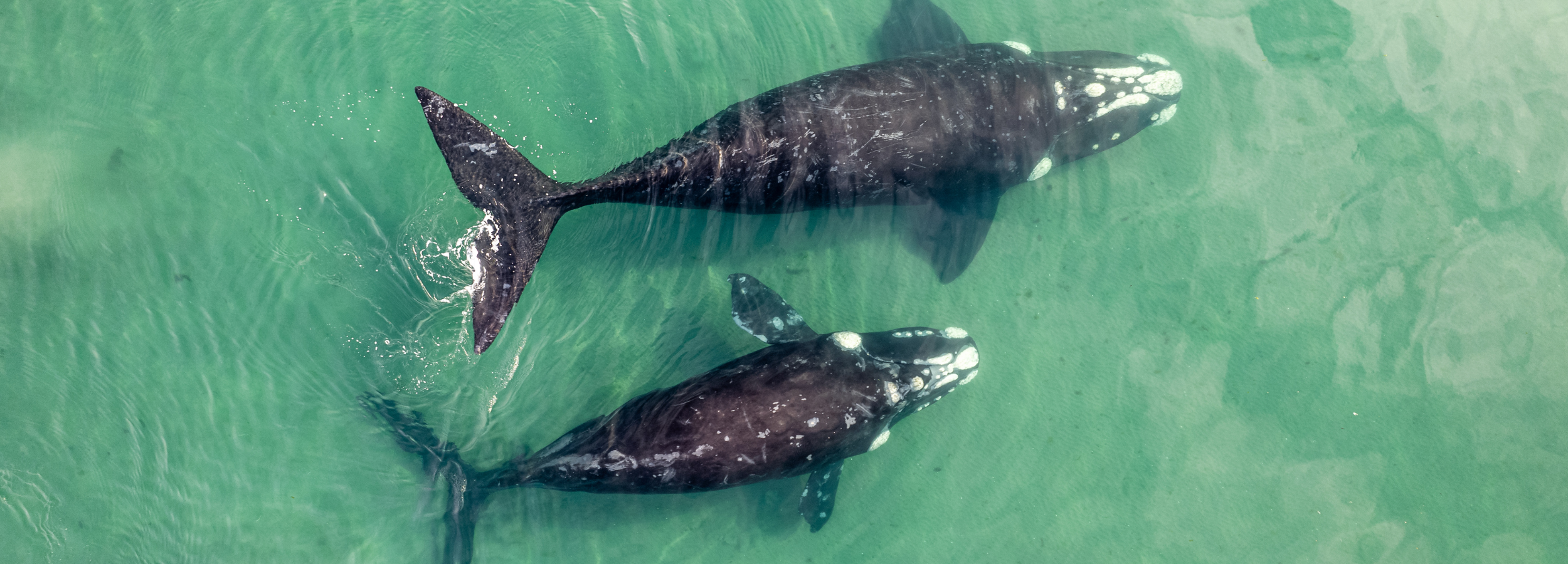
Hunted almost to extinction, southern right whales (Eubalaena australis) are one of these sentinel species. Although this species rebounded significantly once hunting ceased, that growth has now slowed, raising concern among scientists about what might be driving the change. Southern right whales are what is termed 'capital breeders', meaning that they do not feed while pregnant and nursing their young and rely solely of stores of fat and energy reserves collected during the summer months. These whales tend to follow a 3-year reproductive cycle: a year of pregnancy, a year of lactation and nursing their offspring, and a year of rest where females will feed to restore their energy and fat reserves after a long period of fasting. If there are issues with food availability, this can lead to an extension of calving intervals; as such, calving intervals can be a useful measure of the population growth for this species, and whether there are large stressors and threats upon the system.
In this 2026 study, published in Scientific Reports, scientists examined more than three decades of photo‑identification data from southern right whales at Head of Bight, in far west South Australia. This area is a major calving site for the western Australian population of southern right whales, where females come together to give birth to their young.
By tracking individually recognisable females and linking their reproductive histories over the three decades to large‑scale environmental indicators, such as Antarctic sea‑ice extent and oceanographic conditions such as sea surface temperatures and chlorophyll concentrations (chlorophyll is used as a marker for the amount of phytoplankton in the ocean, which are microscopic organisms that form the foundation of almost all marine food webs), researchers were able to show that calving intervals are lengthening beyond the usual 3 year cycle. This means that the reproductive success of southern right whales has decreased and their population growth has slowed.
The analysis indicates that climate change is the dominant driver: reduced sea ice and altered ocean productivity are disrupting the whales’ ability to feed, with their main prey source (krill) in decline and in shifting patches. This consequently leaves females with insufficient energy reserves to sustain their usual cycle of pregnancies and lactation. When compared to observations in South Africa and South America, the findings suggest that southern right whales are signaling broader ecological instability in the Southern Ocean, as a direct result of our changing climate.
There were some identified limitations of the study: as only one location was sampled, this study could not conclusively account for females that may have calved in other areas, so the true calving interval may be different to what was reported. Despite this limitation, the data is still suggestive of an early warning that this species and the Southern Ocean may be at risk, and that further studies are required. Additionally, southern right whales are also at continued risk from human pressures such as vessel strikes, noise, and entanglement, which means that alongside the reduction in calving and the shifts occurring due to climate change, this species is not out of the woods yet and needs further help. As summarised by the researchers, "these findings highlight not only the ecological sensitivity of southern right whales but the urgency of climate-informed management and mitigation strategies".
To read the full publication, click on the link below: https://www.nature.com/articles/s41598-026-36897-1